Names, numbers and odd words — a pronunciation guide
A narrator only knows what the page tells it. How to write invented names, dates, abbreviations and foreign words so they come out the way you hear them in your head.
Most of your manuscript will read perfectly the first time. The handful of words that don't are almost always the same kinds: a character's name, a year, an abbreviation, a word borrowed from another language. Readers glide over them on the page. A narrator has to say them out loud.
You can't coach an AI narrator the way you'd coach a human in a booth. But you control the one thing it listens to: the text. Here's how to write for the ear.
Invented and unusual names
Fantasy and science-fiction authors hit this first. A name like Caoimhe, Xhosa-Ren or Aoibhinn will be guessed at, and the guess changes with the sentence around it.
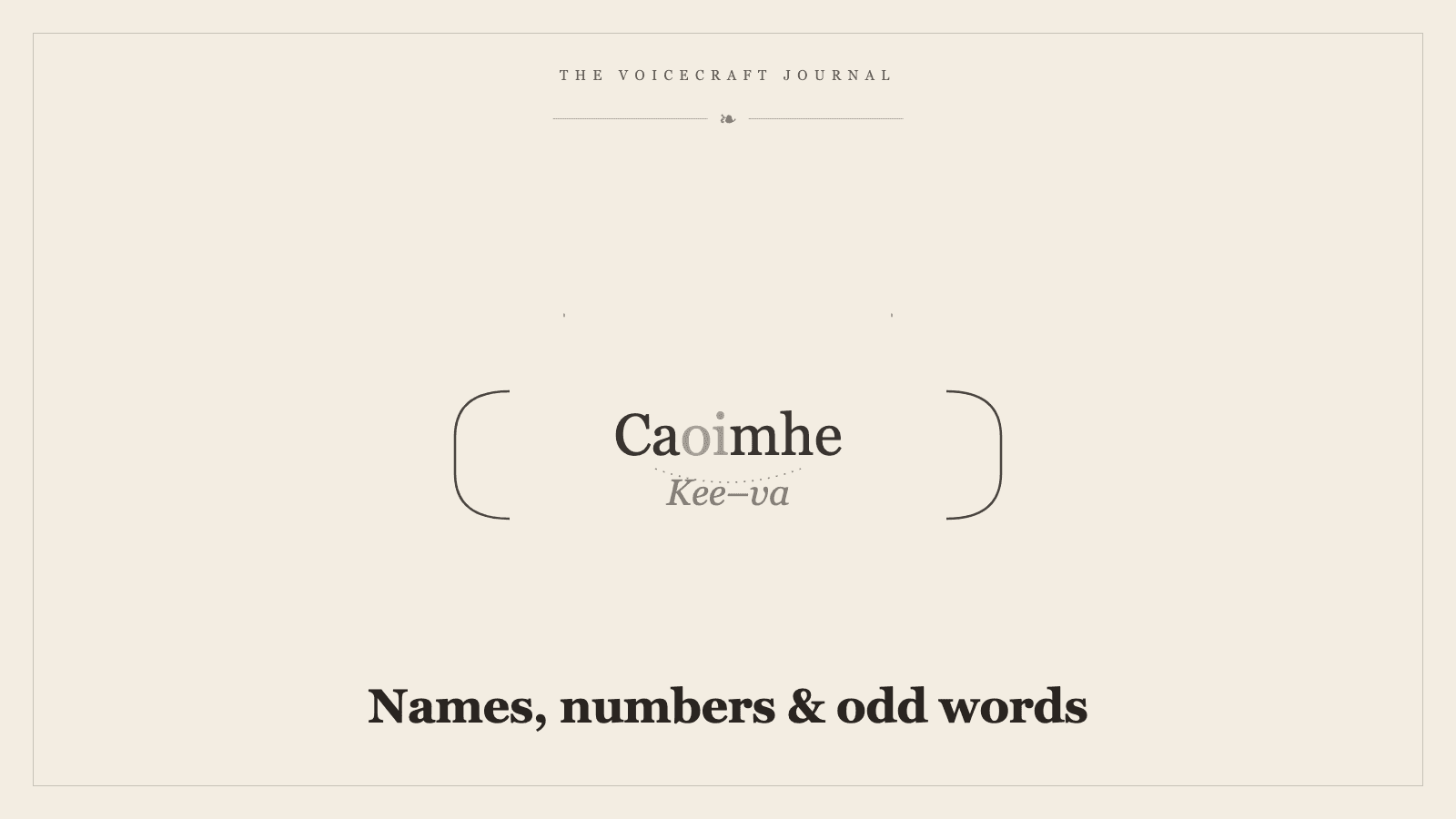
The fix is to spell the name the way it sounds, in the audio edition only. Caoimhe becomes Kee-va. Aoibhinn becomes Ee-veen. Your print and ebook editions keep the real spelling, and the listener never sees the respelling.
Two habits help:
- Keep a pronunciation list as you go: one line per name, with the spelling you settled on. Use the same respelling in every chapter, or the name will drift.
- Test the name in context, not on its own. Narrate the chunk where the name first appears. A name that sounds right in a list can shift in the middle of a sentence.
Numbers, dates and money
Numbers are where a reader's eye and a listener's ear disagree most. 1916 could be "nineteen sixteen" or "one thousand nine hundred and sixteen". 3/4 could be a date or a fraction.
If there's any doubt, write it out:
- Years: nineteen sixteen, if that's how you'd say it.
- Dates: the fourth of March, not 4/3, which a listener in another country will hear as April.
- Money: forty pounds, not £40.
- Ranges: between ten and twelve, not 10–12.
Plain numbers in running text, like three children or 200 miles, usually come out fine. Save the rewriting for the ones that could be read two ways.
Abbreviations and initials
Dr., St., NATO and U.S. each follow a different rule, and a narrator doesn't always know which one you meant. St. could be Saint or Street.
Write out anything that could be read two ways. Saint Andrews, not St. Andrews. For initialisms you want spelled letter by letter, spacing them out as F B I is often the most reliable. Acronyms that are said as words, like NATO or UNESCO, can stay as they are.
Foreign words and phrases
A French phrase in an English sentence may come out in an English accent, or come out correctly and sound jarring. Decide which you want before you listen, because both have their place.
If a character is meant to stumble over a phrase, leave it as written. If the phrase should sound native, try it on the Standard or Studio lane first, then respell it by sound if it still doesn't land. Keep borrowed phrases short. A single word inside an English sentence is much easier to get right than a whole foreign sentence.
Links, symbols and formatting
The narrator already handles most formatting for you. It reads the words of a link and drops the web address, reads the text inside emphasis and skips the asterisks. What it can't know is what a symbol means. Replace &, %, # and → with the words you'd say. Write and, per cent, number and leads to.
Check it once, fix it for good
The quickest way to find these words is to narrate your first chapter on Quick and listen with the manuscript open. Every time you wince, fix the text, not the audio, and add the word to your pronunciation list. By chapter three the list covers almost everything, and the rest of the book tends to go through on the first render.